
The factory had been empty for as long as anyone remembered.
It squatted at the edge of town like a sleeping animal — all broken windows and rusted beams, vines snaking through old brick. Kids used to dare each other to sneak inside. Teenagers spray-painted their names on its exterior walls and ran away laughing.
By the time Rowan Hale was twenty-nine, the factory was just part of the background of his bus ride to work. A landmark of nothing-ever-happens-here. A monument to jobs that had left before he’d even been born.
He never thought it had anything to do with him.
Until the night the bus broke down right in front of it.
“Sorry, folks,” the driver called, tapping the dashboard in frustration. “Looks like she’s done for. I’ve called for a backup, but it’s gonna be a while.”
A collective groan rippled through the half-full bus.
Rowan stared out the window at the dark bulk of the factory.
He’d stayed late at the office again — a place that was technically called “Customer Success” but felt more like “Polite Apologies Forever.” His head buzzed with canned phrases and the blue glare of too many screens. His chest carried that familiar dull weight, the one that came from knowing he was spending his days on something that didn’t mean anything to him.
He pressed his forehead to the cold window glass.
He’d planned, once, to be an illustrator. He’d drawn constantly as a kid. Sketched on napkins. Filled notebooks. Applied to art school and even got in.
Then his dad got sick.
Money got tight.
“Practical” became the word of the year.
He told himself he’d go back to art “once things settled.”
They never really did.
He hadn’t picked up a pencil in over a year.
Now he was watching his exhausted face reflected faintly over the decaying silhouette of the factory, thinking, Is this it? Is this all I do?
Headlights swept past as a car went around the disabled bus.
Something flickered in the factory windows.
Rowan blinked.
It was quick — like a light turning on, then off — but he saw it. A flash from inside. Not lightning. Not a reflection.
Like a single bright eye opening.
Then closing again.
He sat up straighter.
Nobody else on the bus seemed to notice. A teenager scrolled his phone at full brightness. A woman in a suit cursed quietly into her earbuds. The driver sighed, rubbing his temples.
Rowan looked back at the factory.
Nothing.
Then, from somewhere behind his ribs, a very old, very quiet part of him whispered:
Go look.
He almost laughed.
At what? Ruins? Rat parties? Creepy iron ghosts?
But the whisper came again, stronger this time.
Go look.
His hand moved before his brain agreed.
He pulled the cord.
The bus hissed its doors open.
“I’m gonna walk it,” Rowan told the driver. “It’s not far for me.”
“Suit yourself,” the driver said. “Watch your step.”
Rowan stepped down onto the cracked asphalt, the night air cool on his face. The bus doors closed behind him.
The neighborhood was quiet. Streetlights hummed softly. The sky had that sodium-orange tint cities wore like a cheap coat.
He crossed the road toward the fence around the factory.
Up close, it was even more of a wreck. “KEEP OUT” signs hung at drunken angles. The gate was chained but not very enthusiastically.
Rowan stood there for a good thirty seconds, arguing with himself.
This is stupid.
You’re tired.
Go home.
Another flicker of light winked from somewhere deep inside the factory’s shadowed windows.
His heart kicked.
“Fine,” he muttered. “Five minutes. Then I leave.”
He squeezed through a gap in the fence and stepped onto the grounds.
The air inside the yard was cooler, quieter, as if the outside sounds had decided this place wasn’t their business.
Weeds poked through old concrete. Broken glass crunched under his sneakers. Rowan moved carefully, his phone flashlight cutting a narrow cone through the dark.
He pushed through a door hanging half-off its hinges and entered the main floor.
It was huge.
Moonlight streamed through shattered windows high above, drawing pale rectangles on the cracked floor. Old machinery hulks sat in the shadows— silent giants rusting toward nothing.
“Okay,” he whispered. His voice echoed. “You’ve looked. Congratulations. Now you go home and—”
The light came again.
Not from the windows.
From deeper inside.
A steady, low glow, like a lantern held just around a corner.
Rowan swallowed.
“Hello?” he called — because that’s what people always did in bad movies right before something jumped out.
Nothing jumped out.
But the light pulsed, once, as if in answer.
He followed.
It led him through a side corridor, past a toppled stack of wooden pallets, into what had once been an office. Papers lay scattered and brittle on the floor. A metal desk rusted in one corner. A calendar on the wall still showed a year three decades past.
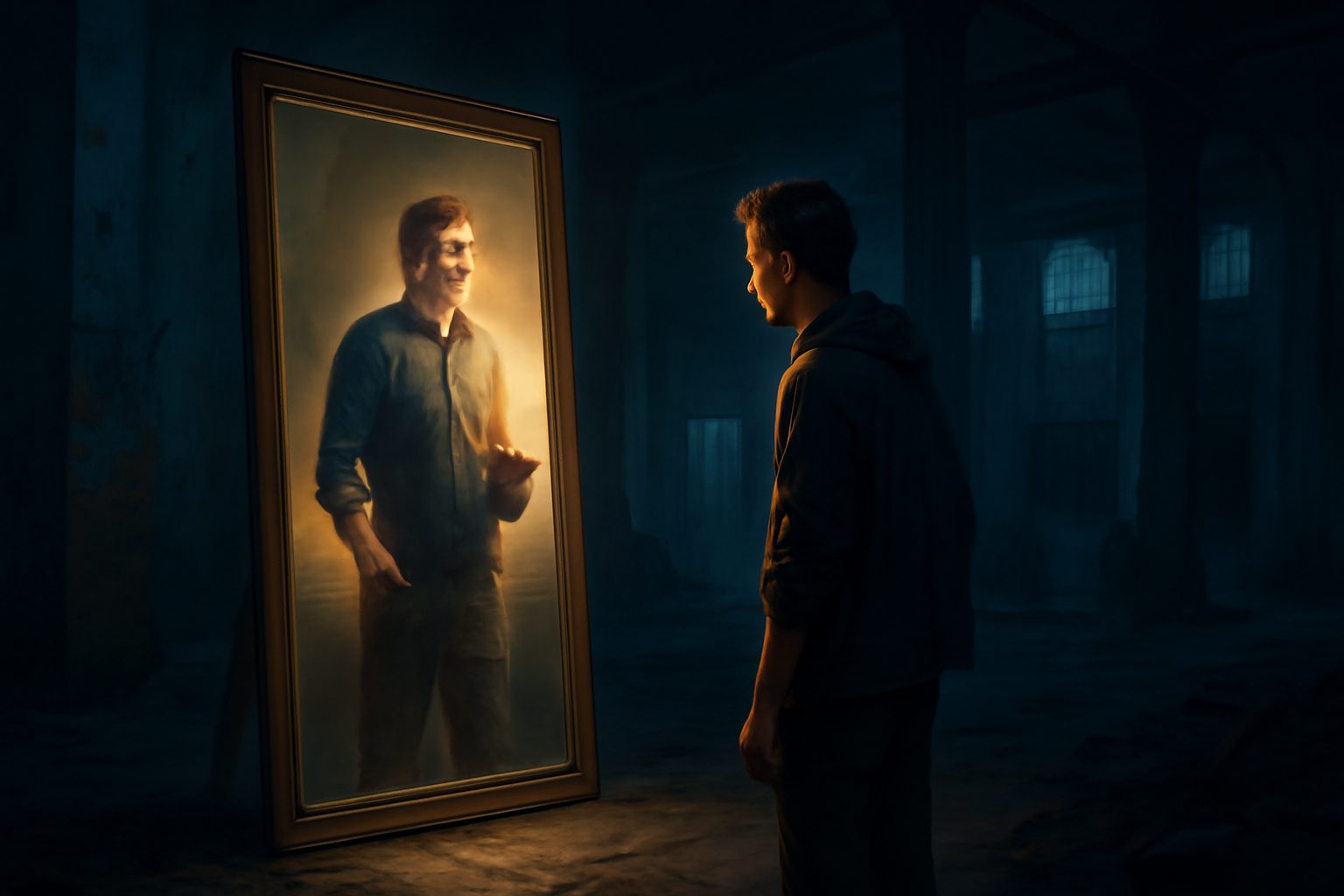
And on the opposite wall hung a mirror.
Tall. Framed in tarnished brass.
The glass was the source of the light — a soft glow that came not from anything reflected, but from within.
Rowan stopped in the doorway.
Something in his chest stuttered.
The mirror showed him.
But not as he was now.
As he could be.
In the glass, he saw a version of himself sitting at a big wooden table in a sunlit room, pencil in hand, surrounded by drawings.
They were good.
Not perfect, not gallery-ready, but alive. Messy and full of motion, full of feeling. Characters he recognized from old sketchbooks stood alongside new ones, bold and weird and wonderful.
Mirror-Rowan was laughing at something. Head tipped back. Relaxed in a way Current-Rowan hadn’t been in years.
On the wall behind him hung a framed print with his name at the bottom.
It looked like the cover of a book.
Rowan’s throat closed.
“No,” he whispered. “That can’t be me. I—that’s over. I missed my chance.”
The man in the mirror glanced up, as if he’d heard.
His eyes met Rowan’s.
And he smiled.
Not a smug ha, look what you could have had smile.
A gentle, you found me smile.
Then the image rippled and changed.
Now the mirror showed another version of Rowan.
He was at the same table, but everything around him was dimmer. The drawings were half-started, abandoned. His shoulders were tighter. The framed print on the wall was blank.
He was on a video call. The reflection of a corporate logo flickered on the dark window behind him. He spoke with a practiced, polite expression that made something inside Current-Rowan ache.
APOLOGIES FOR THE INCONVENIENCE, his lips said.
When the call ended, mirror-Rowan sat there in the quiet.
He looked so tired.
So small.
He put his head down on the desk for a moment.
Then stood up mechanically and walked away.
The room faded to dark.
Two lives.
Two paths.
Both, somehow, him.
Rowan staggered back.
“What is this?” he demanded, voice shaking. “Some kind of—of emotional trap? Pick your future, kids, see which disappointment you win?”
A voice that wasn’t a voice hummed through the room.
If the factory had a heart, it had just turned its attention to him.
The mirror glowed brighter.
A line of words appeared at the top of the glass, written in a script that looked like his own handwriting and something older layered together:
THIS IS WHO YOU BECOME
IF YOU ARE BRAVE.
AND IF YOU ARE NOT.
His heart hammered.
He thought of all the days he’d told himself it was too late to start over. That he wasn’t talented enough. That art was a childish dream. That being grateful for a steady paycheck was more important than being honest about what he wanted.
“I can’t just quit,” he said aloud. “I have bills. My dad’s medical debt. People depend on me. I’m not some dramatic movie character who throws it all away to ‘follow his passion.’”
The mirror flickered.
The brave-version scene returned — but now, it zoomed in.
He saw small details.
Not some fantasy overnight success.
Him at the office, still answering calls. But sketching in the margins of his notebook.
Him taking a night class at the community center. Hesitant at first, then less so.
Him setting up a tiny desk in the corner of his bedroom dedicated just to drawing.
Him posting one illustration online.
Then three.
Then ten.
Not thousands of likes.
Just a few.
But enough to make his chest expand.
Enough to keep going.
He watched mirror-him send an email with shaking hands — portfolio attached — to a small indie publisher looking for artists.
He watched a reply arrive.
We’d love to talk.
He watched mirror-him cry with relief.
Rowan pressed his palm to the real-world side of the glass.
“I’m scared,” he whispered.
The brave-version of himself looked up from his drawing.
He didn’t say, Don’t be.
He seemed to say, Me too. We did it anyway.
The mirror shifted again, this time showing something unexpected.
Rowan sitting in a chair across from his father in a small, cozy room filled with plants. His father looked healthier than Current-Rowan’s memory, but still older, still marked by illness.
“I used to think I failed you,” mirror-Rowan was saying. “Not becoming what you wanted. Not being the practical one.”
His father chuckled.
“I wanted you to be happy,” he said. “And I wanted you to be okay when I was gone. That’s it. I never asked you to martyr yourself on my behalf.”
Tears glinted in mirror-Rowan’s eyes.
“I stayed,” he said.
“I know,” his father replied. “And I’m grateful. But staying isn’t the same as never doing anything for you.”
He reached out, squeezed his son’s hand.
“You get to live, Rowan. Not just… endure.”
The image blurred.
Rowan realized he was sobbing.
He hadn’t even noticed.
“I don’t know how to start,” he choked.
The mirror shimmered.
New words appeared along the bottom edge.
ONE BRAVE THING.
THAT’S ALL.
THEN THE NEXT.
He laughed, a wet, shaky sound.
“One brave thing,” he repeated.
His reflection stared back at him now — the real him, standing in an abandoned factory, eyes red, cheeks streaked.
He looked… different.
Not redeemed.
Not transformed.
Just more honest.
“Okay,” he whispered to himself. “First brave thing. I can do one.”
He slipped his phone from his pocket and opened his email app.
Subject line:
Request to move to part-time
His hands shook.
Dear Erin, I’m writing to ask whether we could explore the possibility of me transitioning to part-time hours over the next few months…
He hovered over “send.”
“This is stupid,” he muttered. “They’ll say no. They’ll think I’m ungrateful.”
The mirror glowed.
His reflection nodded at him.
Send.
He hit the button.
The email whisked away into the digital ether.
He exhaled so hard it felt like something left his body along with the breath.
“Okay,” he murmured. “Okay. That’s one.”
The mirror’s light softened.
The images faded.
All that remained was his own reflection, eyes tired but shining, standing a little straighter than when he’d arrived.
A final message glimmered across the glass:
YOU DON’T HAVE TO BECOME HIM OVERNIGHT.
YOU JUST HAVE TO STOP WALKING AWAY FROM HIM.
Rowan pressed his palm flat against the cool surface.
“Thank you,” he said.
The mirror pulsed once more, like a heartbeat.
Then the light went out.
By the time Rowan found his way back out of the factory, the backup bus had long come and gone. The street was empty. The night was still.
He walked home.
In the morning, there was an email from Erin.
Rowan,
Let’s talk. The timing isn’t ideal, but I’ve noticed how hard you’ve been working and I don’t want to lose you entirely. Maybe we can trial a reduced schedule for three months and see how it goes?
Also — are you okay? You haven’t taken a vacation in two years. Let’s discuss.
— E.
Rowan stared at the screen.
Then he went to his closet.
He pulled out the box he hadn’t opened in ages — the one with old sketchbooks, pencils worn to stubs, a set of watercolors he’d never even taken out of the packaging.
He set them on the small table by his window.
The table looked too small to hold a future.
It held the first brave thing just fine.
He sat down.
Opened a sketchbook to a clean page.
His hand trembled.
He drew anyway.
Lines at first, messy and unsure.
Then shapes.
Then a figure: a man standing in front of a mirror in a cavernous, empty building, light pouring out of the glass.
As he added the last stroke, the morning sun broke through the clouds outside, pouring a stripe of warmth across his page.
The drawing wasn’t perfect.
It was honest.
It was his.
He smiled a little.
“Nice to meet you,” he whispered to the version of himself on the page — the one who was scared and moving anyway.
And somewhere, in an abandoned factory that no one noticed anymore, a tarnished brass mirror glowed briefly in the dark —
— pleased that another person had seen not just who they were,
but who they could become
if they were brave.